
Have you ever looked at a simple cantrip and wondered, “Can this really change a fight?” I asked myself the same question when I first read about Booming Blade. At first, it looked basic. However, once I saw it used in real combat, I realised it offers far more than just extra damage.
In Dungeons & Dragons 5th Edition, Booming Blade is not only about hitting harder. Instead, it is about control, timing, smart positioning, and forcing enemies to make difficult choices. Let’s explore everything in clear and simple English.
Table of Contents
ToggleWhat Is Booming Blade?
Booming Blade is an evocation cantrip introduced in Tasha’s Cauldron of Everything. It allows you to make a melee weapon attack and surround your enemy with magical thunder energy.
Here are the basics:
-
Casting Time: 1 action
-
Range: Self (5 feet)
-
Components: Somatic and a melee weapon worth at least 1 silver piece
-
Duration: 1 round
-
Spell Type: Evocation cantrip
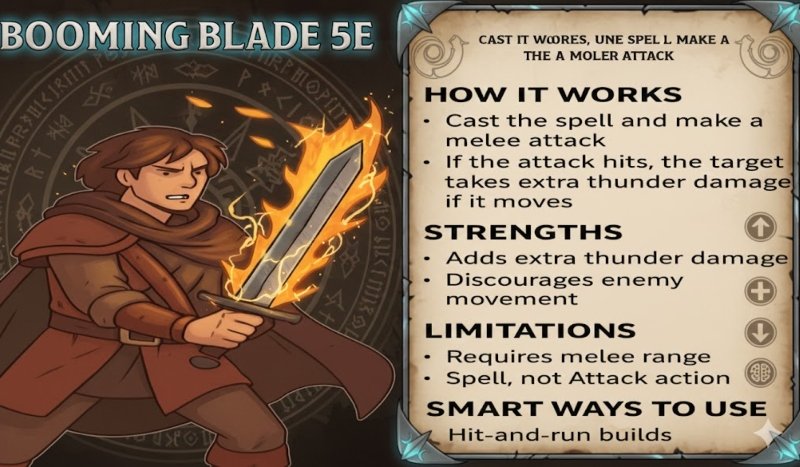
When you cast it, you make one melee attack against a creature within 5 feet. If you hit, the target takes normal weapon damage. Then the creature becomes wrapped in booming energy.
If that creature willingly moves 5 feet or more before your next turn, it takes extra thunder damage. After that, the spell ends.
So the enemy faces a clear choice: stay still or take more damage.
How Booming Blade Scales With Level
One reason players love this spell is that it grows stronger with you.
-
Levels 1–4: Weapon damage only on hit. Movement deals 1d8 thunder damage.
-
Levels 5–10: +1d8 thunder damage on hit. Movement deals 2d8 thunder damage.
-
Levels 11–16: +2d8 thunder damage on hit. Movement deals 3d8 thunder damage.
-
Levels 17–20: +3d8 thunder damage on hit. Movement deals 4d8 thunder damage.
At level 5, it becomes much stronger because you now deal extra thunder damage on the initial hit. As you level up, the movement damage becomes very dangerous.
How Booming Blade Really Works
Many players misunderstand this spell, so let’s clear that up.
First, Booming Blade uses your action. It is not a bonus action. Once you cast it, that is your main action for the turn.
Second, it does not give extra attacks. You only make one melee attack as part of the spell. If you have Extra Attack, you cannot combine it with Booming Blade during the same action.
However, you can still use your bonus action and movement normally.
So, each turn you must decide:
Do you take normal attacks, or do you use Booming Blade for added pressure?
Why Players Love Booming Blade
Adds Tactical Depth
Booming Blade changes how combat feels. When you hit someone, they must think carefully before moving. This makes combat more strategic and satisfying.
Scales Without Spell Slots
Because it is a cantrip, you can cast it unlimited times. Even better, it scales with your level. So it stays useful from the early game to high-level play.
Works for Many Builds
Unlike many spells that only fit pure casters, Booming Blade blends magic and weapons. That makes it popular among hybrid characters.
Best Classes for Booming Blade
Warlock
Warlocks are one of the strongest users. A Pact of the Blade Warlock can combine weapon attacks with magical bonuses. Features like Hex or Hexblade’s Curse increase the overall damage even more.
Sorcerer
Sorcerers benefit from Metamagic. With Quickened Spell, you can cast Booming Blade and still take other actions, which opens creative strategies.
Bard
Melee-focused Bards use Booming Blade for steady damage without spending spell slots. It fits well in combat-heavy builds.
Cleric
Frontline Clerics, especially martial domains, can use Booming Blade to strengthen their close combat presence.
Artificer and Eldritch Knight
These classes mix weapons and magic naturally. Booming Blade fits perfectly into their playstyle and improves their melee impact.
Smart Tactics for Using Booming Blade
Control Enemy Movement
When you hit an enemy, they must decide whether to move. If they stay, they may lose position. If they move, they take extra damage. Either way, you control the flow.
Punish Retreats
Enemies who try to escape your reach risk triggering thunder damage. This makes it harder for them to reposition safely.
Use Reach Weapons
With a reach weapon, you can apply pressure from 10 feet away. That keeps you safer while still threatening movement damage.
Combine With War Caster
If you take the War Caster feat, you can cast Booming Blade as an opportunity attack. This makes it even more punishing for enemies who try to run.
Pair With Control Spells
You can combine it with spells like Hold Person or Entangle. These spells limit movement, which makes the threat of thunder damage even more powerful.
Booming Blade vs Other Cantrips
Here is how it compares to similar spells in Dungeons & Dragons 5th Edition:
Booming Blade: Best for melee control and punishing movement.
Green-Flame Blade: Good when two enemies stand close together.
Shocking Grasp: Useful for preventing enemy reactions.
Fire Bolt: Strong ranged damage option.
Eldritch Blast: Excellent ranged damage for Warlocks.
If you want battlefield control in melee combat, Booming Blade often stands out.
Influence in 2026 and Beyond
Even in 2026, Booming Blade remains one of the most discussed melee cantrips. Players frequently recommend it in build guides and online discussions. Many Dungeon Masters appreciate its balance between damage and strategy.
While spells do not have a financial “net worth,” Booming Blade holds strong value in terms of influence and popularity. It continues to shape melee caster builds and hybrid character concepts in modern campaigns.
Frequently Asked Questions
Is Booming Blade a cantrip?
Yes. You can cast it unlimited times.
Can I use it with Extra Attack?
No. Casting it replaces your Attack action.
Does it work if the enemy does not move?
If the enemy does not move willingly, they do not take the extra thunder damage.
Can I use it with a reach weapon?
Yes. Reach weapons work normally with the spell.
Conclusion
Booming Blade may look simple at first. However, once you understand its mechanics, it becomes a powerful tactical tool.
It rewards smart positioning. It forces enemies to make difficult decisions. It supports many creative character builds. Most importantly, it adds depth to melee combat.
If you play a frontline spellcaster in D&D 5e, Booming Blade deserves serious consideration. Use it wisely, plan your positioning, and you will see how much impact one “simple” cantrip can truly have.